

Documentation Index

Fetch the complete documentation index at: https://langchain-5e9cc07a-preview-change-1779831223-d853e2d.mintlify.app/llms.txt

Use this file to discover all available pages before exploring further.
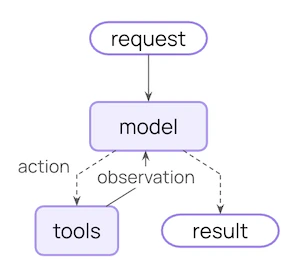
An agent is a model calling tools in a loop until a given task is complete. Core agent loop diagram
Agent = Model + HarnessThe job of a harness: get the model the right context at the right time for the given task.
A harness is everything around that loop: the model, its prompt, its tools, and any middleware that shapes its behavior. create_agent is a highly configurable harness. At its simplest:
from langchain.agents import create_agent

agent = create_agent("openai:gpt-5.4", tools=tools)
Configure the basics directly — model=, tools=, system_prompt=. For more advanced capabilities, extend the harness with middleware.

Core components

Model

Pass a model identifier string ("provider:model") or an initialized model instance. See Models for parameters, provider setup, and dynamic model selection.
from langchain.agents import create_agent

agent = create_agent("openai:gpt-5.4", tools=tools)

Tools

Pass any Python callable, LangChain tool, or tool dict. See Tools for tool definition, context access, and dynamic tool selection.
from langchain.tools import tool

@tool
def search(query: str) -> str:
    """Search for information."""
    return f"Results for: {query}"

agent = create_agent("openai:gpt-5.4", tools=[search])

System prompt

Shape how the agent approaches tasks. Accepts a string or SystemMessage. For dynamic prompts at runtime, use middleware.
agent = create_agent(
    "openai:gpt-5.4",
    tools=tools,
    system_prompt="You are a helpful assistant. Be concise and accurate.",
)

Structured output

Return a validated schema from the agent using response_format=. See Structured output for strategies and examples.
from pydantic import BaseModel
from langchain.agents import create_agent

class Answer(BaseModel):
    summary: str
    confidence: float

agent = create_agent("openai:gpt-5.4", tools=tools, response_format=Answer)
result = agent.invoke({"messages": [{"role": "user", "content": "Summarize AI trends"}]})
result["structured_response"]  # Answer(summary=..., confidence=...)

Name

Optional identifier used as the node name when embedding this agent as a subgraph in multi-agent systems.
agent = create_agent("openai:gpt-5.4", tools=tools, name="research_assistant")
To extend the agent’s state schema with custom fields, use state_schema on create_agent or define it via middleware. See Memory for details.

Invocation

Trace each step of this loop, debug tool calls, and evaluate agent outputs with LangSmith. Follow the tracing quickstart to get set up.
You can invoke an agent by passing an update to its State. All agents include a sequence of messages in their state; to invoke the agent, pass a new message along with a thread_id so the agent can persist and resume conversation history:
from langchain.agents import create_agent
from langchain_core.utils.uuid import uuid7
from langgraph.checkpoint.memory import InMemorySaver

agent = create_agent(
    model="google_genai:gemini-3.5-flash",
    tools=[],
    checkpointer=InMemorySaver(),
)

config = {"configurable": {"thread_id": str(uuid7())}}

result = agent.invoke(
    {"messages": [{"role": "user", "content": "What's the weather in San Francisco?"}]},
    config=config,
)

# A follow-up turn on the same conversation: reuse the same thread_id to keep history
result = agent.invoke(
    {"messages": [{"role": "user", "content": "What about tomorrow?"}]},
    config=config,
)
Persisting conversation history with thread_id requires the agent to be configured with a checkpointer. When deployed on LangSmith, a checkpointer is provisioned automatically. Locally, pass one explicitly, for example create_agent(..., checkpointer=InMemorySaver()).
If you also need to pass per-run configuration (such as a user ID, API keys, or feature flags) to tools and middleware, pass it as context alongside config. Define the shape of that data with context_schema and access it through runtime.context:
from dataclasses import dataclass

from langchain.agents import create_agent
from langchain_core.utils.uuid import uuid7
from langchain_openai import ChatOpenAI
from langgraph.checkpoint.memory import InMemorySaver


@dataclass
class Context:
    user_id: str


agent = create_agent(
    model="google_genai:gemini-3.5-flash",
    tools=[],
    context_schema=Context,
    checkpointer=InMemorySaver(),
)

result = agent.invoke(
    {"messages": [{"role": "user", "content": "What's the weather in San Francisco?"}]},
    config={"configurable": {"thread_id": str(uuid7())}},
    context=Context(user_id="user-123"),
)
thread_id scopes the conversation (message history, checkpoints), while context carries per-run data your tools and middleware read at invocation time. Both are commonly passed together. See tool context and Runtime for more.

Streaming

We’ve seen how the agent can be called with invoke to get a final response. If the agent executes multiple steps, this may take a while. To show intermediate progress, we can stream back messages as they occur.
from langchain.messages import AIMessage, HumanMessage

for chunk in agent.stream({
    "messages": [{"role": "user", "content": "Search for AI news and summarize the findings"}]
}, stream_mode="values"):
    # Each chunk contains the full state at that point
    latest_message = chunk["messages"][-1]
    if latest_message.content:
        if isinstance(latest_message, HumanMessage):
            print(f"User: {latest_message.content}")
        elif isinstance(latest_message, AIMessage):
            print(f"Agent: {latest_message.content}")
    elif latest_message.tool_calls:
        print(f"Calling tools: {[tc['name'] for tc in latest_message.tool_calls]}")
For more details on streaming, see Streaming.

Configure the harness

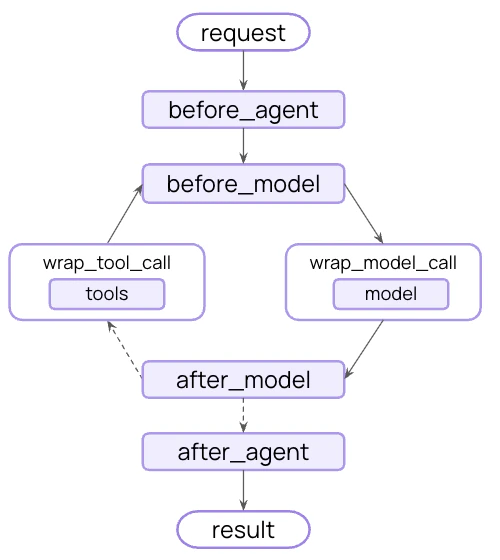
create_agent is highly extensible. Middleware is the primitive for customization: each piece handles one concern, hooks into the agent loop at the right moment, and composes freely with any other. Take exactly what your use case needs — skip the rest. Common patterns are pre-built as first-class middleware. Anything custom is one middleware away. Middleware lifecycle diagram As agents take on complex work, they need support across a few key areas. The middleware ecosystem covers each:
Execution environment

Tools, filesystem, sandboxes, and code execution

Context management

Summarization, memory, skills, and prompt caching

Planning and delegation

Todo lists and subagents for parallel, isolated work

Fault tolerance

Retries, fallbacks, and call limits

Guardrails

PII detection and content controls

Steering

Human-in-the-loop approval before high-impact actions

Execution environment

Agents are useful when they can take action — not just generate text. The execution environment gives the agent a workspace: tools it can call, a filesystem for reading and writing files across turns, and code execution for running scripts or shell commands.
from langchain.agents import create_agent
from deepagents.backends import StateBackend
from deepagents.middleware import FilesystemMiddleware

agent = create_agent(
    model="anthropic:claude-sonnet-4-6",
    tools=[search],
    middleware=[FilesystemMiddleware(backend=StateBackend())],
)
See FilesystemMiddleware, Sandboxes, Interpreters.

Context management

Every model call has a fixed context window. As an agent runs — accumulating history, tool results, and intermediate steps — that window fills. Summarization compresses history before overflow hits; memory loads persistent instructions at startup so knowledge carries across sessions; skills surface domain knowledge on demand rather than loading everything upfront.
from deepagents.backends import StateBackend
from deepagents.middleware import FilesystemMiddleware, MemoryMiddleware, SkillsMiddleware, SummarizationMiddleware

backend = StateBackend()
model = "anthropic:claude-sonnet-4-6"

agent = create_agent(
    model=model,
    tools=[search],
    middleware=[
        FilesystemMiddleware(backend=backend),
        SummarizationMiddleware(model=model, backend=backend),
        MemoryMiddleware(backend=backend, sources=["./AGENTS.md"]),
        SkillsMiddleware(backend=backend, sources=["./skills/"]),
    ],
)
See SummarizationMiddleware, MemoryMiddleware, SkillsMiddleware, Context engineering.

Planning and delegation

Complex tasks often exceed what one context window can handle. Delegation lets the main agent break work into pieces, hand them to subagents that each run in their own isolated context, and stay focused on coordination rather than execution. Work can run in parallel; the main agent’s context stays clean.
from langchain.agents.middleware import TodoListMiddleware
from deepagents import SubAgent
from deepagents.middleware import FilesystemMiddleware, SubAgentMiddleware

researcher: SubAgent = {
    "name": "researcher",
    "description": "Searches and returns a structured summary.",
    "tools": [search],
}

agent = create_agent(
    model="anthropic:claude-sonnet-4-6",
    tools=[search],
    middleware=[
        FilesystemMiddleware(backend=StateBackend()),
        TodoListMiddleware(),
        SubAgentMiddleware(backend=StateBackend(), subagents=[researcher]),
    ],
)
See SubAgentMiddleware, Subagents.

Fault tolerance

Agents in production encounter failures that rarely appear in development: rate limits, model timeouts, transient API errors. Fault tolerance middleware handles these at the infrastructure level so your tools and business logic don’t need try/catch around every call.
from langchain.agents.middleware import ModelRetryMiddleware, ToolRetryMiddleware

agent = create_agent(
    model="anthropic:claude-sonnet-4-6",
    tools=[search],
    middleware=[
        ModelRetryMiddleware(max_retries=3),
        ToolRetryMiddleware(max_retries=2),
    ],
)
See ModelRetryMiddleware, ToolRetryMiddleware, Prebuilt middleware.

Guardrails

Some policies can’t live in a prompt — they need to be enforced deterministically regardless of what the model does. Guardrails intercept data as it flows through the agent loop, applying compliance rules or content policies before tool results reach the model’s context.
from langchain.agents.middleware import PIIMiddleware

agent = create_agent(
    model="anthropic:claude-sonnet-4-6",
    tools=[search],
    middleware=[PIIMiddleware()],
)
See PIIMiddleware, Prebuilt middleware.

Steering

Full autonomy isn’t always appropriate. Steering lets you place humans at specific decision points — before destructive writes, expensive API calls, or anything requiring judgment — without restructuring your agent. The agent pauses and waits; a human approves, edits, or rejects; execution continues.
from langchain.agents.middleware import HumanInTheLoopMiddleware

agent = create_agent(
    model="anthropic:claude-sonnet-4-6",
    tools=[search],
    middleware=[HumanInTheLoopMiddleware(interrupt_on={"write_file": True})],
)
See HumanInTheLoopMiddleware, Human-in-the-loop.
create_deep_agent pre-assembles this stack for long-running coding and research tasks (filesystem, summarization, subagents, and prompt caching included by default). See Deep Agents for the full pre-built harness.
Middleware resources: